Progress & Man Hours
Track how far along work is, by stage and by project.
Last updated About 2 hours ago
Introduction
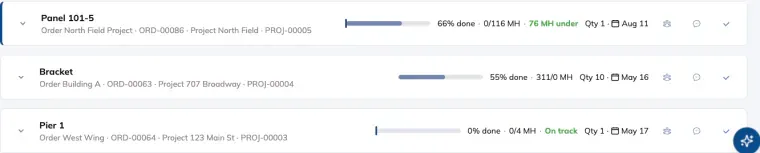
Every order and every stage in Building Swell carries the same one-line summary: how far along it is, the man-hours behind it, and whether that pace holds up. Here is how to read it, and where the numbers come from.
Reading the line
A card reading 86% done · 1871/94 MH · 1790 MH over breaks into three parts.
"MH over" is about pace, not budget
Building Swell compares the hours you have spent against the hours your current progress should have used, not against the whole plan. At 86% done on a 94 MH plan, roughly 81 hours should be spent. 1,871 are. The gap between those two is what the line reports.
So an item can read MH over while it still has planned hours left. Ten percent done on a 100 MH plan with 40 hours logged reads 30 MH over, even though 60 hours of the plan are untouched.
Small gaps read as On track
A difference under one man-hour shows as On track rather than a number, so rounding does not nag you.
No planned hours, no verdict
An item with no planned man-hours has nothing to pace against. The line shows the spent and planned figures and stops there. If you want the verdict, the planned hours come from cycle time on the route. See Cycle Time, Duration, and Float.
Spent hours are net of breaks
The spent figure has shift breaks deducted, so it reflects hours worked rather than hours on the clock.
Stage by stage
Expand an order to see the stages underneath it. Each stage carries its own line, read exactly the same way, alongside who is assigned to it.
The badges on a stage row tell you where it stands. Active marks the stage the work is on now. Rework marks a stage the work was sent back to.

Finding the work you care about
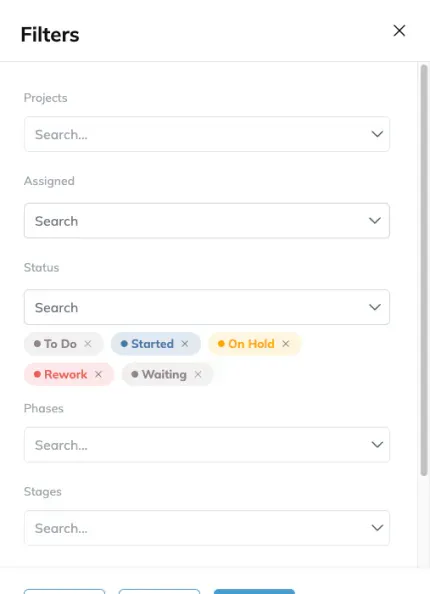
The Filters drawer narrows the board. Two of its filters answer progress questions directly.
Stages. What is sitting at a given station right now.
Phases. What has reached a given part of the lifecycle.
Status carries five values: To Do, Started, On Hold, Rework and Waiting.
Where else you see it
Build shows the same line on every card, and covers laying the board out: the list and grid views, grouping and sorting.
Planning carries the same figures across the whole schedule.
Dashboards rolls progress up by shop and by project over time.
Tips
A large pace gap on a low percentage is worth opening up. Expand the order to see which stage the hours actually landed on.
Nothing after the planned figure means the item has no planned hours, so no pace verdict can be worked out.
Conclusion
One line, three parts: how far along, hours spent against hours planned, and whether the pace holds. It reads the same on an order, on a stage, and everywhere the figures appear.